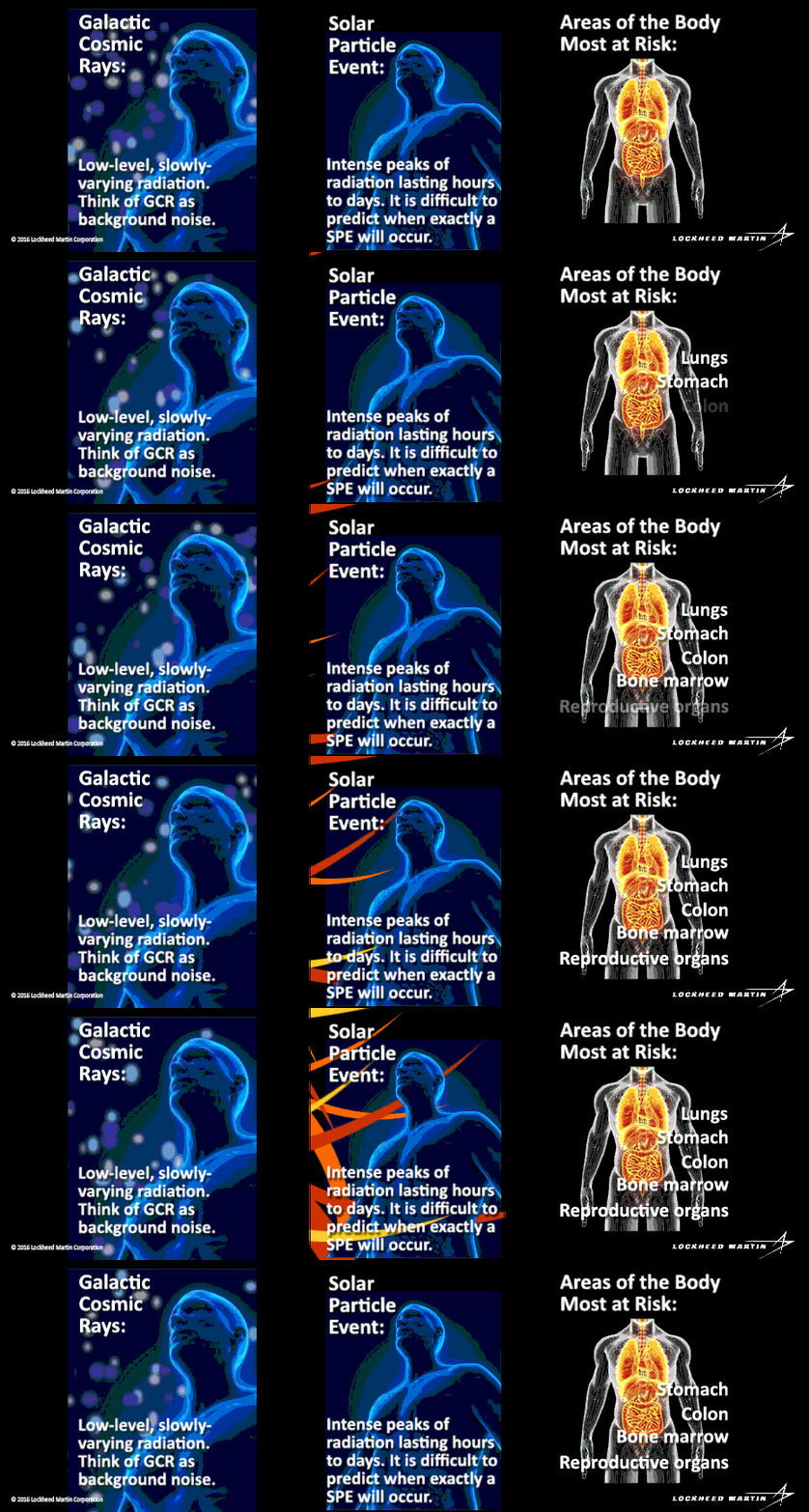
A Preview-
The criteria for what constitutes human spaceflight vary. The Fédération Aéronautique Internationale (FAI) Sporting Code for astronautics recognizes only flights that exceed analtitude of 100 kilometers (62 mi). In the United States, professional, military, and commercial astronauts who travel above an altitude of 50 miles (80 km) are awardedastronaut wings.
As of 8 June 2013, a total of 532 people from 36 countries have reached 100 km (62 mi) or more in altitude, of which 529 reached low Earth orbit or beyond. Of these, 24 peoplehave traveled beyond Low Earth orbit, to either lunar or trans-lunar orbit or to the surface of the moon; three of the 24 did so twice: Jim Lovell, John Young and Eugene Cernan. The three astronauts who have not reached low Earth orbit are spaceplane pilots Joe Walker,Mike Melvill, and Brian Binnie.
As of 20 June 2011, under the U.S. definition 538 people qualify as having reached space, above 50 miles (80 km) altitude. Of eight X-15 pilots who exceeded 50 miles (80 km) in altitude, only one exceeded 100 kilometers (about 62 miles). Space travelers have spent over 41,790 man-days (114.5 man-years) in space, including over 100 astronaut-days ofspacewalks. As of 2008, the man with the longest cumulative time in space is Sergei K. Krikalev, who has spent 803 days, 9 hours and 39 minutes, or 2.2 years, in space.[10][11] Peggy A. Whitson holds the record for the most time in space by a woman, 377 days.
Soviet Space Program-
The Soviet space program comprised the rocketry and space explorationprograms conducted by the former Soviet Union (USSR) from the 1930s untilits dissolution in 1991. Over its sixty-year history, this primarily classifiedmilitary program was responsible for a number of pioneering accomplishments in space flight, including the first intercontinental ballistic missile first animal in Earth orbit (the dogLaika on Sputnik 2), first human in space and Earth orbit (cosmonaut Yuri Gagarin on Vostok 1), first woman in space and Earth orbit (cosmonautValentina Tereshkova on Vostok 6), first spacewalk (cosmonaut Alexey Leonov on Voskhod 2), first Moon impact (Luna 2), first image of the far side of the moon (Luna 3) and unmanned lunar soft landing (Luna 9), first space rover (Lunokhod 1), first sample of lunar soil automatically extracted and brought to Earth (Luna 16), and first space station (Salyut 1). Further notable records included the first interplanetary probes: Venera 1 and Mars 1 to fly by Venus and Mars, respectively, Venera 3 and Mars 2 to impact the respective planet surface, and Venera 7 and Mars 3 to make soft landings on these planets.
The rocket and space program of the USSR, initially boosted by the assistance of captured scientists from the advanced German rocket program, was performed mainly by Soviet engineers and scientists after 1955, and was based on some unique Soviet and Imperial Russian theoretical developments, many derived by Konstantin Eduardovich Tsiolkovskii, sometimes known as the father of theoretical astronautics. Sergey Korolev (also transliterated as Korolyov) was the head of the principal design group; his official title was "chief designer" (a standard title for similar positions in the USSR). Unlike its American competitor in the "Space Race", which had NASA as a single coordinating agency, the USSR's program was split among several competing design groups led by Korolev, Mikhail Yangel, Valentin Glushko, and Vladimir Chelomei.
Because of the program's classified status, and for propaganda value, announcements of the outcomes of missions were delayed until success was certain, and failures were sometimes kept secret. Ultimately, as a result of Mikhail Gorbachev's policy of glasnost in the 1980s, many facts about the space program were declassified. Notable setbacks included the deaths of Korolev, Vladimir Komarov (in the Soyuz 1 crash), and Yuri Gagarin (on a routine fighter jet mission) between 1966 and 1968, and disastrous experiences with the huge N-1 rocket intended to power a manned lunar landing, and which exploded shortly after launch on each of four unmanned tests.
With the collapse of the Soviet Union, Russia and Ukraine inheirited the program. Russia created the Russian Aviation and Space Agency, now known as the Russian Federal Space Agency (Roscosmos), while Ukraine created the National Space Agency of Ukraine (NSAU).
Space Travel Milestone-
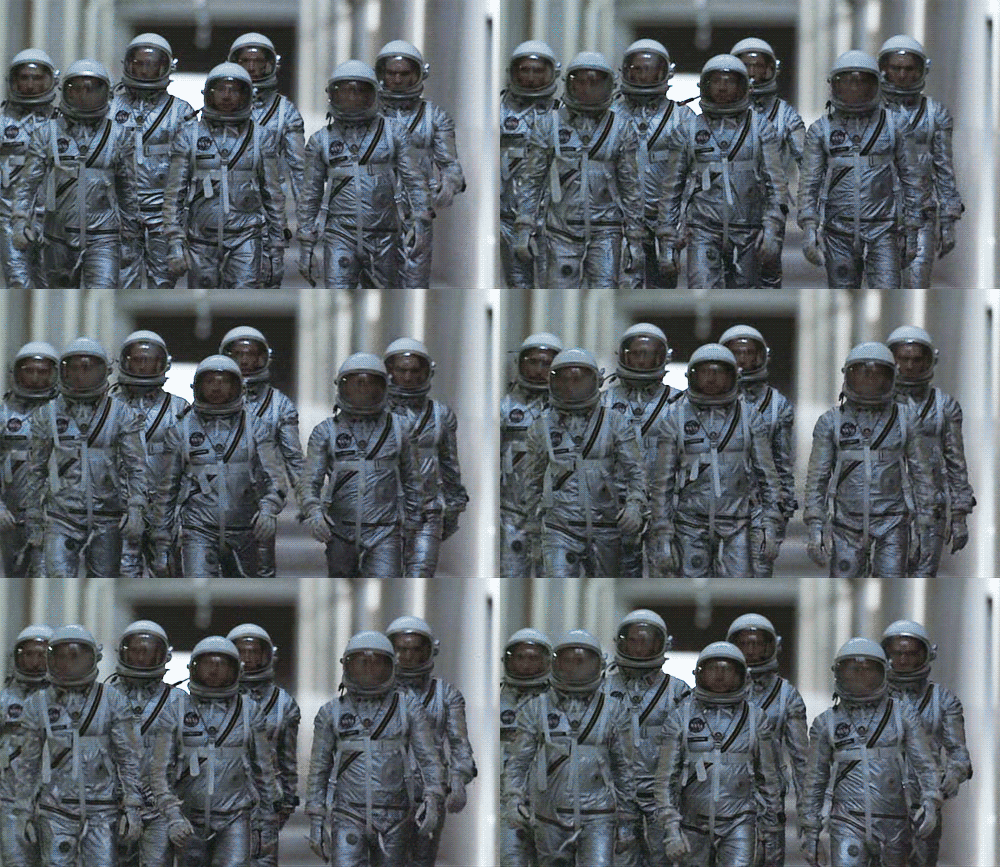
The first human in space was Soviet Yuri Gagarin, who was launched on April 12, 1961 aboard Vostok 1 and orbited around the Earth for 108 minutes. The first woman in space was Soviet Valentina Tereshkova, who launched on June 16, 1963 aboard Vostok 6 and orbited Earth for almost three days.
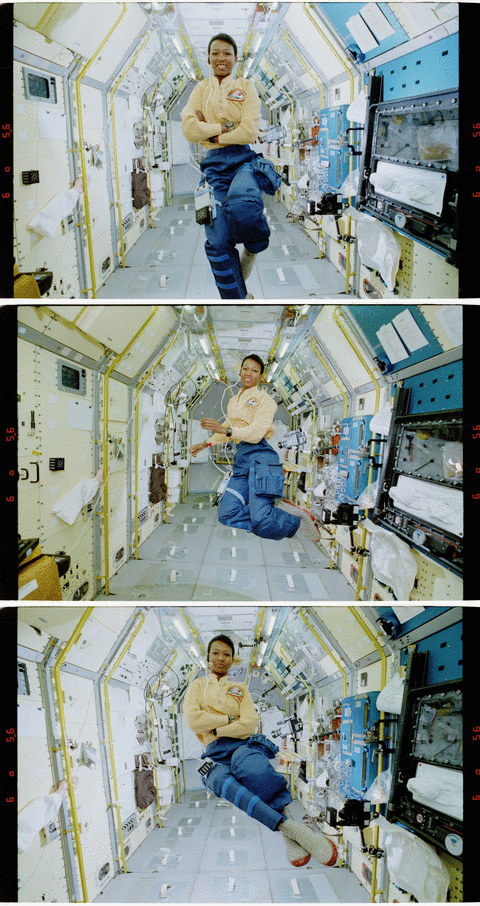
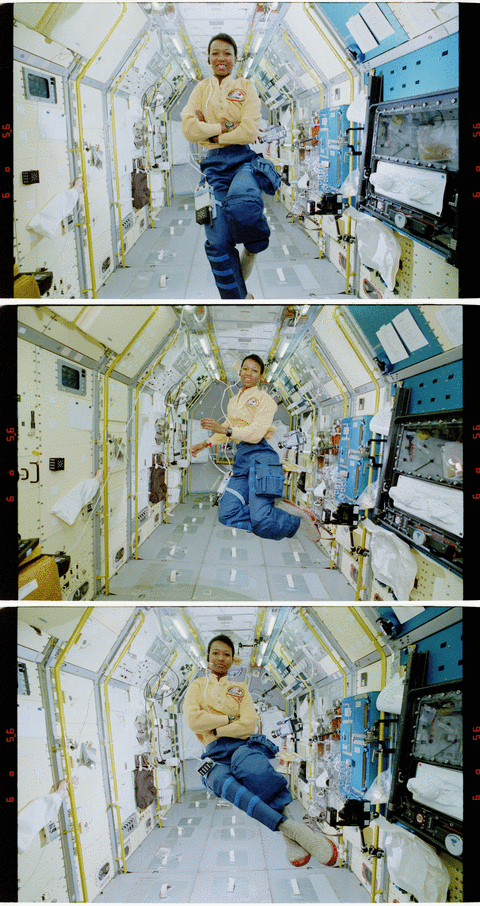
Alan Shepard became the first American and second person in space on May 5, 1961 on a 15-minute sub-orbital flight. The first American woman in space was Sally Ride, duringSpace Shuttle Challenger's mission STS-7, on June 18, 1983.[28] In 1992 Mae Jemisonbecame the first African American woman to travel in space aboard STS-47.
Cosmonaut Alexei Leonov was the first person to conduct an extravehicular activity (EVA), (commonly called a "spacewalk"), on March 18, 1965, on the Soviet Union's Voskhod 2 mission. This was followed two and a half months later by astronaut Ed White who made the first American EVA on NASA's Gemini 4 mission.
The first manned mission to orbit the Moon, Apollo 8, included American William Anders who was born in Hong Kong, making him the first Asian-born astronaut in 1968.
The Soviet Union, through its Intercosmos program, allowed people from other "socialist" (i.e. Warsaw Pact and other Soviet-allied) countries to fly on its missions, with the notable exception of France participating in Soyuz TM-7. An example is Czechoslovak Vladimír Remek, the first cosmonaut from a country other than the Soviet Union or the United States, who flew to space in 1978 on a Soyuz-U rocket.
On July 23, 1980, Pham Tuan of Vietnam became the first Asian in space when he flew aboard Soyuz 37. Also in 1980, Cuban Arnaldo Tamayo Méndez became the first person of Hispanic and black African descent to fly in space, and in 1983, Guion Bluford became the first African American to fly into space. In April 1985, Taylor Wang became the first ethnic Chinese person in space. The first person born in Africa to fly in space wasPatrick Baudry (France), in 1985. In 1985, Saudi Arabian Prince Sultan Bin Salman Bin AbdulAziz Al-Saud became the first Arab Muslim astronaut in space. In 1988, Abdul Ahad Mohmand became the first Afghan to reach space, spending nine days aboard the Mirspace station.
With the larger number of seats available on the Space Shuttle, the U.S. began taking international astronauts. In 1983, Ulf Merbold of West Germany became the first non-US citizen to fly in a US spacecraft. In 1984, Marc Garneau became the first of 8 Canadian astronauts to fly in space (through 2010). In 1985, Rodolfo Neri Vela became the first Mexican-born person in space. In 1991, Helen Sharman became the first Briton to fly in space. In 2002, Mark Shuttleworth became the first citizen of an African country to fly in space, as a paying spaceflight participant. In 2003, Ilan Ramon became the first Israeli to fly in space, although he died during a re-entry accident.
Civilian and non-government milestones-
The first civilian in space was Valentina Tereshkova aboard Vostok 6 (she also became the first woman in space on that mission). Tereshkova was only honorarily inducted into the USSR's Air Force, which had no female pilots whatsoever at that time. A month later, Joseph Albert Walker became the first American civilian in space when his X-15 Flight 90 crossed the 100 kilometers (54 nautical miles) line, qualifying him by the international definition of spaceflight. Walker had joined the US Army Air Force but was not a member during his flight. The first people in space who had never been a member of any country's armed forces were both Konstantin Feoktistov and Boris Yegorov aboard Voskhod 1.
The first non-governmental space traveler was Byron K. Lichtenberg, a researcher from the Massachusetts Institute of Technology who flew on STS-9 in 1983.[48] In December 1990, Toyohiro Akiyama became the first paying space traveler as a reporter for Tokyo Broadcasting System, a visit to Mir as part of an estimated $12 million (USD) deal with a Japanese TV station, although at the time, the term used to refer to Akiyama was "Research Cosmonaut".[49][50][51] Akiyama suffered severe space sickness during his mission, which affected his productivity.
The first self-funded space tourist was Dennis Tito on board the Russian spacecraft Soyuz TM-3 on April 28, 2001.
Space Tourism-
The Soviet space program was aggressive in broadening the pool of cosmonauts. The Soviet Intercosmos program included cosmonauts selected from Warsaw Pact members (from Czechoslovakia, Poland, East Germany, Bulgaria, Hungary, Romania) and later from allies of the USSR (Cuba, Mongolia, Vietnam) and non-aligned countries (India, Syria, Afghanistan). Most of these cosmonauts received full training for their missions and were treated as equals, but especially after the Mirprogram began, were generally given shorter flights than Soviet cosmonauts. The European Space Agency (ESA) took advantage of the program as well.
The U.S. space shuttle program included payload specialist positions which were usually filled by representatives of companies or institutions managing a specific payload on that mission. These payload specialists did not receive the same training as professional NASA astronauts and were not employed by NASA. In 1983, Ulf Merbold from ESA and Byron Lichtenberg from MIT (engineer and Air Force fighter pilot) were the first payload specialists to fly on the Space Shuttle, on mission STS-9.
In 1984, Charles D. Walker became the first non-government astronaut to fly, with his employer McDonnell Douglas paying $40,000 for his flight. :74–75 NASA was also eager to prove its capability to Congressional sponsors. Senator Jake Garnwas flown on the Shuttle in 1985, followed by Representative Bill Nelson in 1986.
During the 1970s, Shuttle prime contractor Rockwell International studied a $200–300 million removable cabin that could fit into the Shuttle's cargo bay. The cabin could carry up to 74 passengers into orbit for up to three days. Space Habitation Design Associates proposed, in 1983, a cabin for 72 passengers in the bay. Passengers were located in six sections, each with windows and its own loading ramp, and with seats in different configurations for launch and landing. Another proposal was based on the Spacelab habitation modules, which provided 32 seats in the payload bay in addition to those in the cockpit area. A 1985 presentation to the National Space Society stated that although flying tourists in the cabin would cost $1 to 1.5 million per passenger without government subsidy, within 15 years 30,000 people a year would pay $25,000 each to fly in space on new spacecraft. The presentation also forecast flights to lunar orbit within 30 years and visits to the lunar surface within 50 years.
As the shuttle program expanded in the early 1980s, NASA began a Space Flight Participant program to allow citizens without scientific or governmental roles to fly. Christa McAuliffe was chosen as the first Teacher in Space in July 1985 from 11,400 applicants. 1,700 applied for the Journalist in Space program, including Walter Cronkite, Tom Brokaw, Tom Wolfe, and Sam Donaldson. An Artist in Space program was considered, and NASA expected that after McAuliffe's flight two to three civilians a year would fly on the shuttle. After McAuliffe was killed in the Challenger disaster in January 1986 the programs were canceled. McAuliffe's backup, Barbara Morgan, eventually got hired in 1998 as a professional astronaut and flew on STS-118 as a mission specialist.:84–85 A second journalist-in-space program, in which NASA green-lighted Miles O'Brien to fly on the space shuttle, was scheduled to be announced in 2003. That program was canceled in the wake of theColumbia disaster on STS-107 and subsequent emphasis on finishing the International Space Station before retiring the space shuttle.
With the realities of the post-Perestroika economy in Russia, its space industry was especially starved for cash. The Tokyo Broadcasting System (TBS) offered to pay for one of its reporters to fly on a mission. For $28 million, Toyohiro Akiyama was flown in 1990 to Mir with the eighth crew and returned a week later with the seventh crew. Akiyama gave a daily TV broadcast from orbit and also performed scientific experiments for Russian and Japanese companies. However, since the cost of the flight was paid by his employer, Akiyama could be considered a business traveler rather than a tourist.
In 1991, British chemist Helen Sharman was selected from a pool of 13,000 applicants to be the first Briton in space. The program was known as Project Juno and was a cooperative arrangement between the Soviet Union and a group of British companies. The Project Juno consortium failed to raise the funds required, and the program was almost cancelled. Reportedly Mikhail Gorbachev ordered it to proceed under Soviet expense in the interests of international relations, but in the absence of Western underwriting, less expensive experiments were substituted for those in the original plans. Sharman flew aboard Soyuz TM-12 to Mir and returned aboard Soyuz TM-11.
Orbital space tourism-
At the end of the 1990s, MirCorp, a private venture that was by then in charge of the space station, began seeking potential space tourists to visit Mir in order to offset some of its maintenance costs. Dennis Tito, an American businessman and former JPL scientist, became their first candidate. When the decision to de-orbit Mir was made, Tito managed to switch his trip to the International Space Station (ISS) through a deal between MirCorp and U.S.-based Space Adventures, Ltd., despite strong opposition from senior figures at NASA; from the beginning of the ISS expeditions, NASA stated it wasn't interested in space guests. Nonetheless, Dennis Tito visited the ISS on April 28, 2001, and stayed for seven days, becoming the first "fee-paying" space tourist. He was followed in 2002 by South African computer millionaire Mark Shuttleworth. The third was Gregory Olsen in 2005, who was trained as a scientist and whose company produced specialist high-sensitivity cameras. Olsen planned to use his time on the ISS to conduct a number of experiments, in part to test his company's products. Olsen had planned an earlier flight, but had to cancel for health reasons. The Subcommittee on Space and Aeronautics Committee On Science of the House of Representatives held on June 26, 2001 reveals the shifting attitude of Nasa towards paying space tourists wanting to travel to the ISS. The hearing's purpose was to, "Review the issues and opportunities for flying nonprofessional astronauts in space, the appropriate government role for supporting the nascent space tourism industry, use of the Shuttle and Space Station for Tourism, safety and training criteria for space tourists, and the potential commercial market for space tourism". The subcommittee report was interested in evaluating Dennis Tito's extensive training and his experience in space as a nonprofessional astronaut.
By 2007, space tourism was thought to be one of the earliest markets that would emerge for commercial spaceflight. 11 However, as of 2014 this private exchange market has not emerged to any significant extent.
After the Columbia disaster, space tourism on the Russian Soyuz program was temporarily put on hold, because Soyuz vehicles became the only available transport to the ISS. On July 26, 2005, Space Shuttle Discovery (mission STS-114) marked the shuttle's return to space. Consequently, in 2006, space tourism was resumed. On September 18, 2006, an Iranian American named Anousheh Ansari became the fourth space tourist (Soyuz TMA-9).[20]) On April 7, 2007, Charles Simonyi, an American businessman of Hungarian descent, joined their ranks (Soyuz TMA-10). Simonyi became the first repeat space tourist, paying again to fly on Soyuz TMA-14 in March–April 2009. Canadian Guy Laliberté became the next space tourist in September, 2009 aboard Soyuz TMA-16.
As reported by Reuters on March 3, 2010, Russia announced that the country would double the number of launches of three-man Soyuz ships to four that year, because "permanent crews of professional astronauts aboard the expanded station are set to rise to six"; regarding space tourism, the head of the Russian Cosmonauts' Training Center said "for some time there will be a break in these journeys".
On January 12, 2011, Space Adventures and the Russian Federal Space Agency announced that orbital space tourism would resume in 2013 with the increase of manned Soyuz launches to the ISS from four to five per year. However, this has not materialized, and the current preferred option, instead of producing an additional Soyuz, would be to extend the duration of an ISS Expedition to one year, paving the way for the flight of new spaceflight participants. The British singerSarah Brightman is scheduled for such an assignment in 2015.
Training-
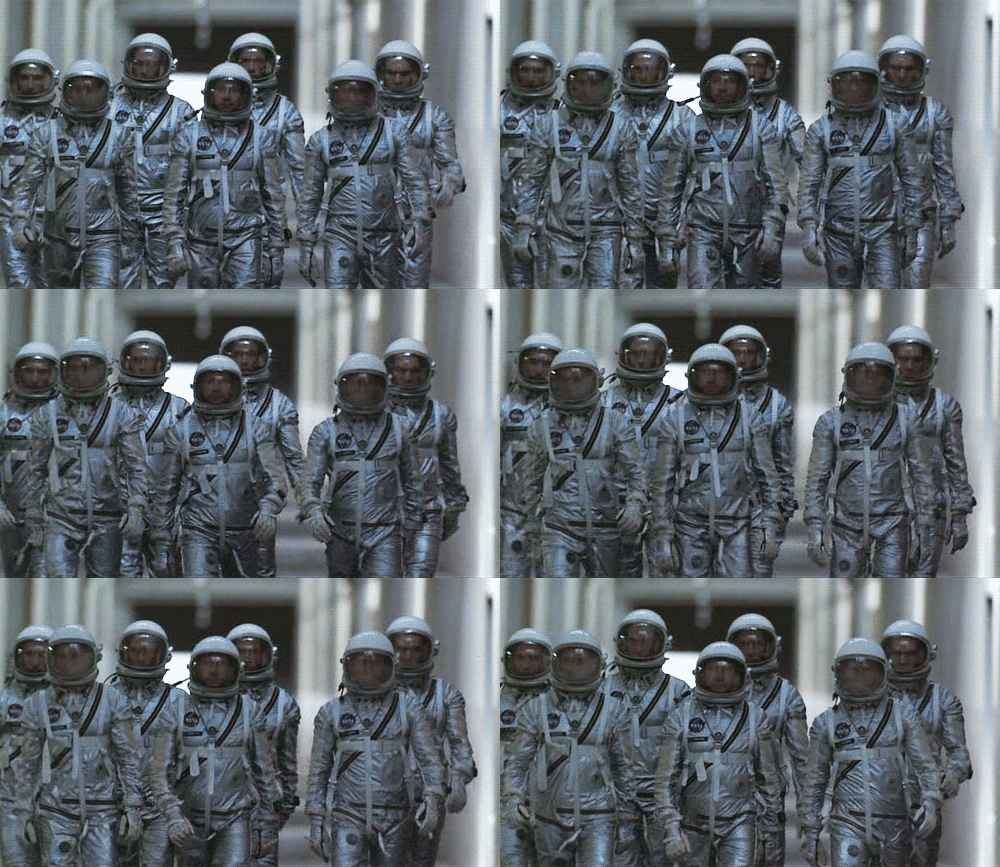
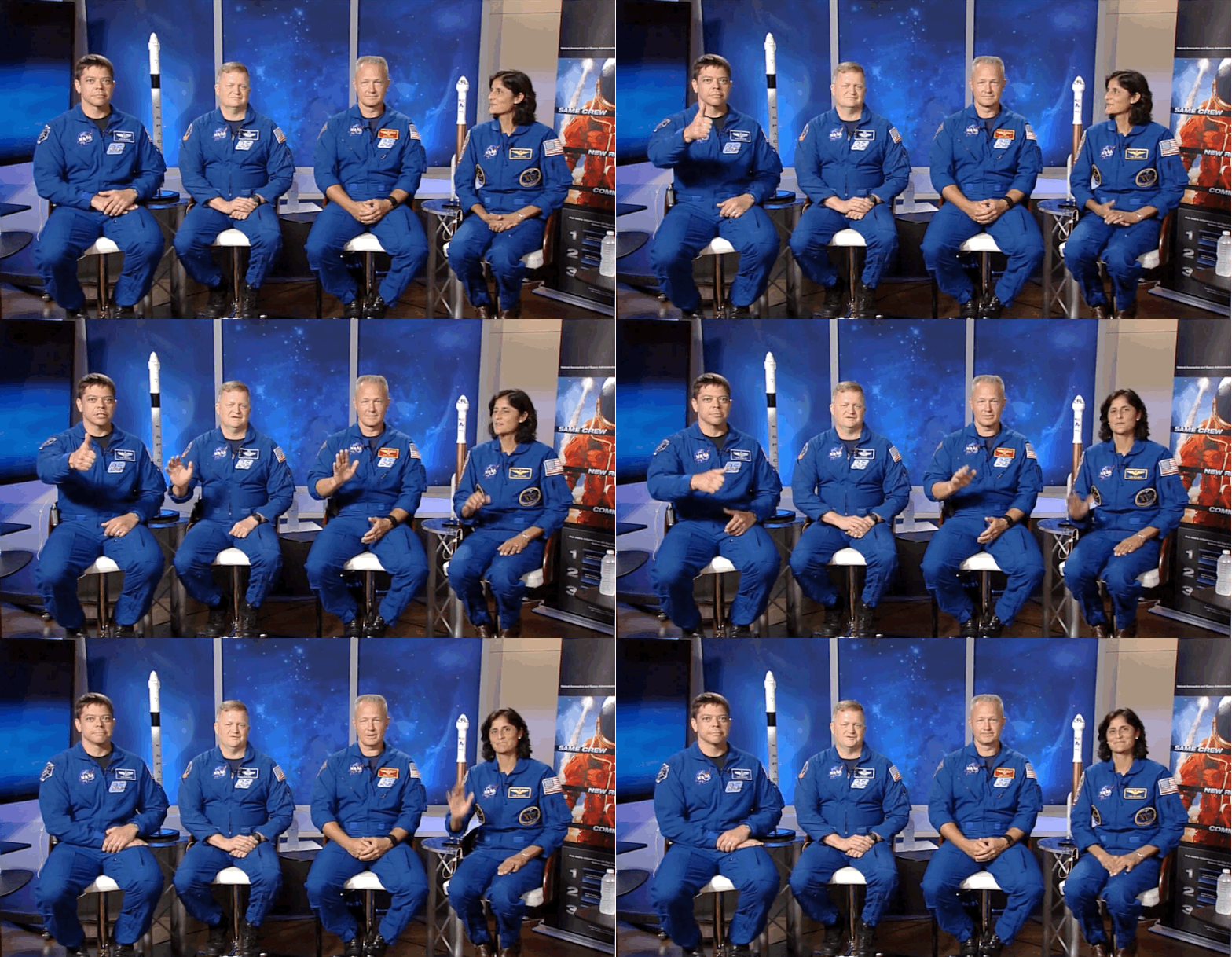
The first NASA astronauts were selected for training in 1959. Early in the space program, military jet test piloting and engineering training were often cited as prerequisites for selection as an astronaut at NASA, although neither John Glenn nor Scott Carpenter (of the Mercury Seven) had any university degree, in engineering or any other discipline at the time of their selection. Selection was initially limited to military pilots. The earliest astronauts for both America and the USSR tended to be jet fighter pilots, and were often test pilots.
Once selected, NASA astronauts go through twenty months of training in a variety of areas, including training for extravehicular activity in a facility such as NASA'sNeutral Buoyancy Laboratory. Astronauts-in-training may also experience short periods of weightlessness in aircraft called the "vomit comet", the nickname given to a pair of modified KC-135s (retired in 2000 and 2004 respectively, and replaced in 2005 with a C-9) which perform parabolic flights. Astronauts are also required to accumulate a number of flight hours in high-performance jet aircraft. This is mostly done in T-38 jet aircraft out of Ellington Field, due to its proximity to the Johnson Space Center. Ellington Field is also where the Shuttle Training Aircraft is maintained and developed, although most flights of the aircraft are done out of Edwards Air Force Base.
